

Other Resources
Everyday tools for a healthier life
A curated grab-bag from the TREWO team: a recipe, a heart-health primer, safety apps and a cybersecurity refresher — the small, practical things worth bookmarking.
Healthy Living

Recipe
Oil-Free Chana Masala
Curried chickpeas in a spicy, oil-free sauce. Serves four to six.
Watch the recipe videoIngredients
- 2 cups dried chickpeas
- 6 cups water
- 1 tsp garam masala
- 1 tsp ground cumin seeds (jeera)
- 1 tsp ground coriander seeds (dhania)
- ½ tsp chilli powder (mirchi)
- 1 tsp dried fenugreek leaves (kasoori methi)
- ½ tsp ground fennel seeds (saunf)
- ½ tsp ground pomegranate seeds (anardana)
- ½ tsp dried ground ginger (saunth)
- 1 medium red onion, diced fine
- 2 tomatoes, diced fine
- 2 green chillies, slit
- 1-inch piece ginger, julienned into slivers
- 4 tbsp chopped fresh coriander (hara dhania)
- 2 tbsp chopped fresh mint (pudina)
- 2 tbsp lemon juice
- 1 tsp toasted ground cumin seeds (bhuna jeera)
- ½ tsp black salt (kala namak)
- Optional toppings: fresh coriander mint chutney (hari chutney), tamarind chutney (imli chutney), chaat masala.
Method
- Wash chickpeas, cover with lots of water and soak overnight. Drain, place in a pressure cooker with 6 cups of water. Cook for 30 minutes or longer until chickpeas are very tender. If you don’t have a pressure cooker, place chickpeas and water in a covered saucepan or an Instapot, and simmer until chickpeas are very tender. Mash lightly to thicken sauce.
- Add spices to chickpeas, cover and simmer 1.5 hours or longer until chickpeas are very soft, and sauce is thick and flavourful.
- Remove from heat and fold in red onion, tomatoes, chillies, ginger and herbs, reserving ¼ cup for garnish.
- Drizzle with fresh coriander mint chutney and tamarind chutney and the chaat masala if using, and top with reserved garnish.
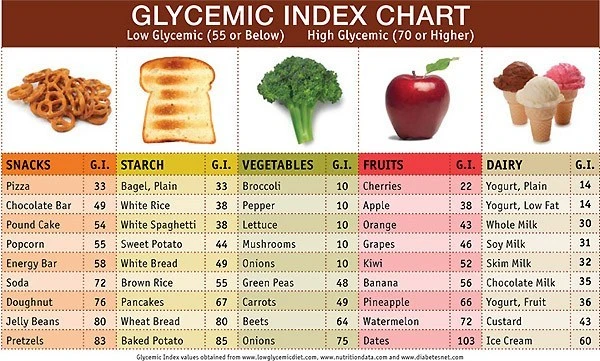
Glycemic Index Chart
A quick-reference chart of low- and high-glycemic foods across snacks, starches, vegetables, fruits and dairy.
Factors Used to Calculate Heart Risk
Things you can’t change
Age, family history of cardiovascular disease, previous history of cardiovascular disease, sex.
Things you can change
Blood pressure, blood sugar/diabetes, BMI, chronic inflammation, diet, exercise, HDL cholesterol, smoking, stress, total cholesterol.
Social factors
Environment, income, social isolation.
Community & Safety
Say No to Being Hacked!
Information privacy and security best practices, from a TREWO webinar with Steve Chapelle.
Terms of Service
All social media and messaging services provide a Terms of Service statement that must be agreed to, typically in the form of a checkbox, to complete account creation. It outlines their right to utilize your profile, postings and messaging content in any form they see fit, without further consent. It is the actual, rather than monetary, price to be paid. Most people do not read it.
Takeaway: Read the agreement before checking the box.
Nothing to Hide
A common misconception for social media users is that all thoughts and images are appropriate for posting if they contain no apparent wrongdoing. But each item contains clues that, in aggregate, can identify vulnerabilities and generate risks. A belief in ‘nothing to hide’ also suggests ‘nothing to protect’ — unrealistic for most, and a risk for connected acquaintances both professional and personal.
Takeaway: Every post and message should have an identifiable purpose that justifies the accompanying hypothetical risks.
Rationalizations
Excuses social media users commonly give themselves for sending risky content include “it was private”, “no one can prove it was me” and “it’s not against the law”. In most situations these ideas are false — our messages and images sit on server hard drives outside Canada, and network monitoring software can detect keywords indicating potential lawbreaking.
Takeaway: If any of the above forms your rationalization for sending an objectionable message or image, just don’t do it.
Phishing
Emails containing hyperlinks and instructions to click on them should be treated with caution. First note the sender’s address and domain (i.e. ‘noreply@apple.com’). Then hover over the hyperlink — taking care not to click it — to see its actual URL. If the domain doesn’t match the sender’s address, it’s likely a phishing trap.
Takeaway: Verify the source of any hyperlink before clicking on it.
Passwords
Minimum 12 alphanumeric characters. Combine two short words, numbers and symbols plus a variable indicating the first (or last) character of the website or app.
Example (create your own variation): Lock500$File
Public WiFi
Online accounts should never be logged into on public WiFi without the protection of a VPN. Without it, unencrypted traffic — including usernames and passwords — can be captured by another device in range using a ‘sniffer’ program.
Takeaway: Use a VPN for private, secure communications, especially financial, legal and medical documents.
Hierarchy of messaging privacy
Messages sent between two separate services won’t be subject to the same protections as those exchanged within the same one — unencrypted messages can be intercepted at multiple points across the internet. Takeaway: determine the most appropriate method based on the message’s confidentiality.
| Common Term | Example | Protocol |
|---|---|---|
| Browser | TOR | IP |
| VPN | Windscribe | IP |
| Message Encrypter | Signal | IP |
| Email Encrypter | ProtonMail | IP |
| Document Encrypter | Zarchiver | IP |
| Snailmail | Letter | Postage |
| Landline | Bell | Circuit |
| Cell Phone | Rogers | 4G |
| Texting | FB Messenger | IP |
| VOIP | Rogers | IP |
| Texting | Bell | SMS |
| Gmail | IP | |
| Social Media – Private | IP | |
| Social Media – Public | IP |
Steve Chapelle has been providing information privacy and security education to Canadian organizations since 2006, following 20+ years in information technology management. He is also an instructor at Udemy and Skillshare, and the author of No Decision: The 1919 Stanley Cup Final. · stevechapelle.ca
The Haven App
Campus Safety
Help, wherever you are
The Haven app has the following features for students:
- Tap the app when you’re at risk of danger, and your loved ones will know your status and location in under 5 seconds.
- Call your loved ones — your “Angels” — in-app, without scrolling your contact list in an emergency.
- Need help now? A script with life-saving information (your location, status, number and more) is ready to relay to emergency operators.
- Use the Destination Timer to let loved ones know when you’ve gotten home safely, without a manual text.
- Learn about consent, what assault is, and when your boundaries have been violated through expert-reviewed Education Pages.
More Worth Bookmarking
The Falls Prevention Programme
Learn more about sponsoring Trillium Health Partners’ Falls Prevention Programme — assessment, exercise and education to help reduce the risk of falls, especially for our aging population.
It’s Time to Rethink What Loneliness Is
Research suggests that chronic loneliness may be as damaging to health as smoking 15 cigarettes a day. But do we know what loneliness actually is?
Children's COVID Vaccination
Advice from Sick Kids Hospital's AboutKidsHealth site — resources to support your child's mental health and general wellbeing.

Join Us. Help Others.
We are deeply grateful to our sponsors — our financial foundation — for providing unwavering stability and support. Every gift helps us reach more seniors, more youth, and more families with the wellness support they deserve.
Donate Now